
Battery Drain and Flat-Spotting: The Two Things That Damage a Stored Vehicle First
Updated: Jun 22
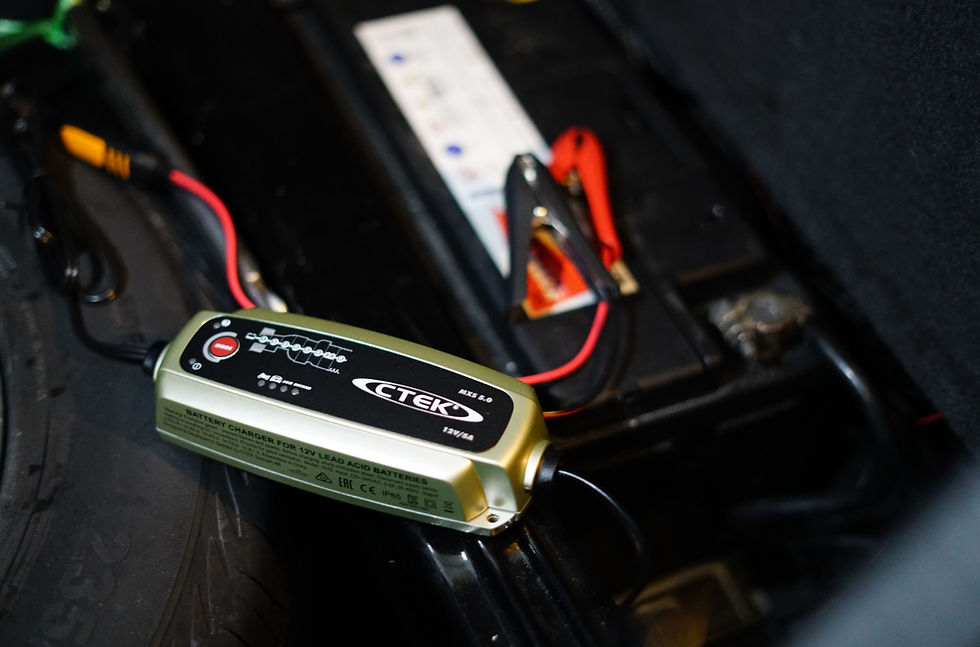
Most owners worry about the obvious things when a car goes into storage — paintwork, rust, the cabin smelling musty after a few months away. Fewer think about the two issues that actually show up first, often within weeks rather than months: a battery that's lost its charge, and tyres that have developed flat spots.
Both are quiet failures. Neither announces itself the way a dent or a scratch does. And both are entirely preventable, provided an owner — or their storage provider — understands what's actually happening and intervenes before it becomes a problem.
Why batteries and tyres are the first things to fail
There's a reason these two components fail before anything else does. Unlike paint, leather, or bodywork, batteries and tyres are *active* systems — they're either being used or they're degrading, with very little middle ground. A car's paintwork can sit untouched for a year and, climate aside, suffer relatively little. A battery left disconnected from any maintenance, or a tyre left bearing the same static load in the same position, begins changing within days.
This is why battery and tyre condition are usually the first two things a recovery technician checks when a stored vehicle is brought out after a long period — and the two most common reasons a car that "should just start" doesn't.
Battery health during long-term storage
Why batteries die faster than owners expect
A car battery isn't designed to sit idle. Even with the engine off, modern vehicles draw a small but constant current — known as parasitic draw — to keep onboard computers, alarm systems, and infotainment memory active. In a vehicle that's being driven regularly, this draw is invisible; the alternator replaces what's lost every time the engine runs. In a vehicle that's sitting in storage, there's nothing replacing that charge, and the battery simply depletes, day after day, until it can no longer start the car or, in worse cases, until it's been damaged by deep discharge.
Conventional batteries vs. start-stop systems
This problem has become more pronounced, not less, as vehicles have become more sophisticated. Older vehicles with simple lead-acid batteries and minimal electronics could often sit for a month or two with only mild charge loss. Modern vehicles — particularly those with start-stop systems, which rely on an AGM (absorbent glass mat) battery built for frequent partial cycling — are far less forgiving. AGM batteries are sensitive to deep discharge and can suffer permanent capacity loss if allowed to drop too low, which means a car with start-stop technology left unmonitored in storage is, in some respects, more vulnerable than the simpler vehicles it replaced.
What proper trickle-charging actually looks like
The fix is straightforward in principle: maintain a small, continuous charge that offsets parasitic draw without overcharging the battery. This is what a trickle charger — more accurately, a "battery maintainer" with float-charge capability — is designed to do. It isn't a matter of plugging in a charger and walking away; the device needs to be matched to the battery chemistry (lead-acid, AGM, or lithium-based in newer EVs and hybrids), set to maintain rather than aggressively charge, and checked periodically to confirm it's actually doing its job.
Warning signs before it's too late
A battery that's been allowed to deep-discharge repeatedly will often show warning signs before it fails outright — slower-than-usual cranking, dashboard warning lights on start-up, or a battery that holds charge for a shorter period each time it's recharged. By the time these signs are visible, however, some damage has typically already occurred. The better approach is never finding out, because the battery has been properly maintained throughout.
Tyre care: preventing flat-spots
What flat-spotting actually is
A flat spot develops when a tyre bears the same static weight, in the same position, for an extended period. The rubber compound — particularly in the contact patch touching the ground — begins to deform slightly under that sustained, unmoving load. Drive the car after a long period of storage and many owners feel it immediately: a faint vibration or thump at speed, caused by the tyre no longer being perfectly round.
In mild cases, flat spots resolve themselves after some driving, as the tyre's heat and flexing work the deformation back out. In more severe cases — particularly with low-profile performance tyres or after extended storage periods — the deformation becomes permanent, and the tyre needs replacing well before it would otherwise have worn out.
Why Malaysia's heat accelerates the process
Heat softens rubber, and Malaysia's ambient temperatures do exactly that throughout the day. A tyre sitting under direct heat — whether from sun exposure or simply Malaysia's general climate — deforms more readily under static load than the same tyre would in a cooler environment. This means flat-spotting, which might take months to develop in a temperate climate, can become a real risk in a matter of weeks under Malaysian conditions if a vehicle is left completely stationary.
Parking a car vs. preparing it for storage
This is where the distinction between "parking" and "storing" a vehicle becomes meaningful. Parking a car simply means leaving it somewhere. Storing it properly means accounting for the fact that it will remain stationary for an extended period, and taking deliberate steps to offset the risks that come with that — whether through correct tyre pressure (often slightly elevated from normal driving pressure, depending on the vehicle and tyre type), periodic repositioning, or in more involved setups, jack stands that take weight off the tyres entirely for very long storage durations.
For most owners storing a vehicle for weeks or months rather than years, the simplest and most effective intervention is movement — physically repositioning or briefly driving the vehicle on a regular schedule, so that no single point on any tyre bears the same static load for too long.
How H&L Park Lane addresses both
These two issues sit at the centre of what H&L Park Lane considers genuine vehicle care, rather than simple storage. Every vehicle on extended storage is monitored for both battery health and tyre condition as a matter of standard practice, not as an optional add-on.
For batteries, H&L Park Lane provides trickle-charging as part of its care protocol — using H&L Park Lane's own maintainers matched to the vehicle's battery type, or, for owners who prefer it, connecting and monitoring the owner's own charging device. Either way, the objective is the same: a vehicle that starts immediately and reliably, with a battery that hasn't been silently degraded by months of neglect.
For tyres, H&L Park Lane runs scheduled vehicle movement as part of its storage protocol, repositioning vehicles at appropriate intervals specifically to prevent flat-spotting before it sets in — rather than waiting for an owner to notice a vibration months later and discover the damage has already been done.
It's a small operational detail in the grand scheme of vehicle ownership, but it's exactly the kind of detail that separates a vehicle that comes out of storage ready to drive from one that needs recovery work before it can be trusted on the road again.
